
Title:
Effect of pipe roughness in sewer networks design located hilly regions
Authors:
Juan Saldarriaga (jsaldarr@uniandes.edu.co)
Sara Criollo (sc.criollo@uniandes.edu.co)
Santiago Acosta (sc.criollo@uniandes.edu.co)
Keywords:
drop manholes; hilly regions; pipe roughness; sensitivity analysis; sewer network design
Highlights:
• Sensitivity analysis of the effect of the pipe roughness in the cost of sewer networks.
• Application of an optimal sewer network design methodology that includes drop manholes.
• Identifying the optimal pipe roughness for sewer network design with drop manholes.
Purpose:
The present work aims to study the effect of pipe roughness on the construction cost of sewer
networks with drop manholes. A previous study suggested that there is an optimal roughness with
which the construction cost is the lowest in sewer networks located in hilly regions. The current work
seeks to prove this hypothesis with a sensitivity analysis in which eight material roughnesses were
tested on four hilly slopes.
Materials and Methods:
To perform the sensibility analysis, two sewer networks of two sectors in Bogotá, Colombia were
used as case studies: Chicó and Cedritos. The original terrain elevation of both networks was modified
to simulate four hilly slopes (2.5, 5, 7.5, and 10%). With each hilly slope, the sewer networks were
designed using eight pipe roughness (0.0015, 0.008, 0.03, 0.1, 0.3, 1, 3, and 6 [mm]) to achieve eight
designs per hilly slope, per sewer network. Also, the procedure was executed using two cost functions:
the one proposed by Li and Matthew (1990) and the one proposed by Maurer et al. (2010).
To design the sewer networks under the conditions mentioned, the methodology of Saldarriaga et al.
(2023) was employed. This methodology expands the work of Duque et al. (2020) by adding the
possibility of including drop manholes in the sewer network design. This is especially useful in hilly
regions, where energy dissipation is necessary to comply with all hydraulic constraints that guarantee
adequate operation of the sewer network.
Duque et al. (2020) models the hydraulic design as a directed graph, where the nodes represent
feasible combinations of pipe diameters and excavation depths, and the arcs represent the diameter
and excavation depth of a particular pipe. These authors proposed to use a shortest path algorithm to
determine the optimal diameters and depths for all pipes in the network, leading to the lowest cost
design.
Saldarriaga et al. (2023) extended this methodology by introducing a new type of arc that represents
drop manholes in the directed graph used for hydraulic design. Through these new arcs, the shortest
path algorithm determines not only the optimal diameters and excavation depths, but also the optimal
number of drop manholes, their locations within the network, and the appropriate drop heights to
meet the hydraulic constraints.
Results and Discussion:
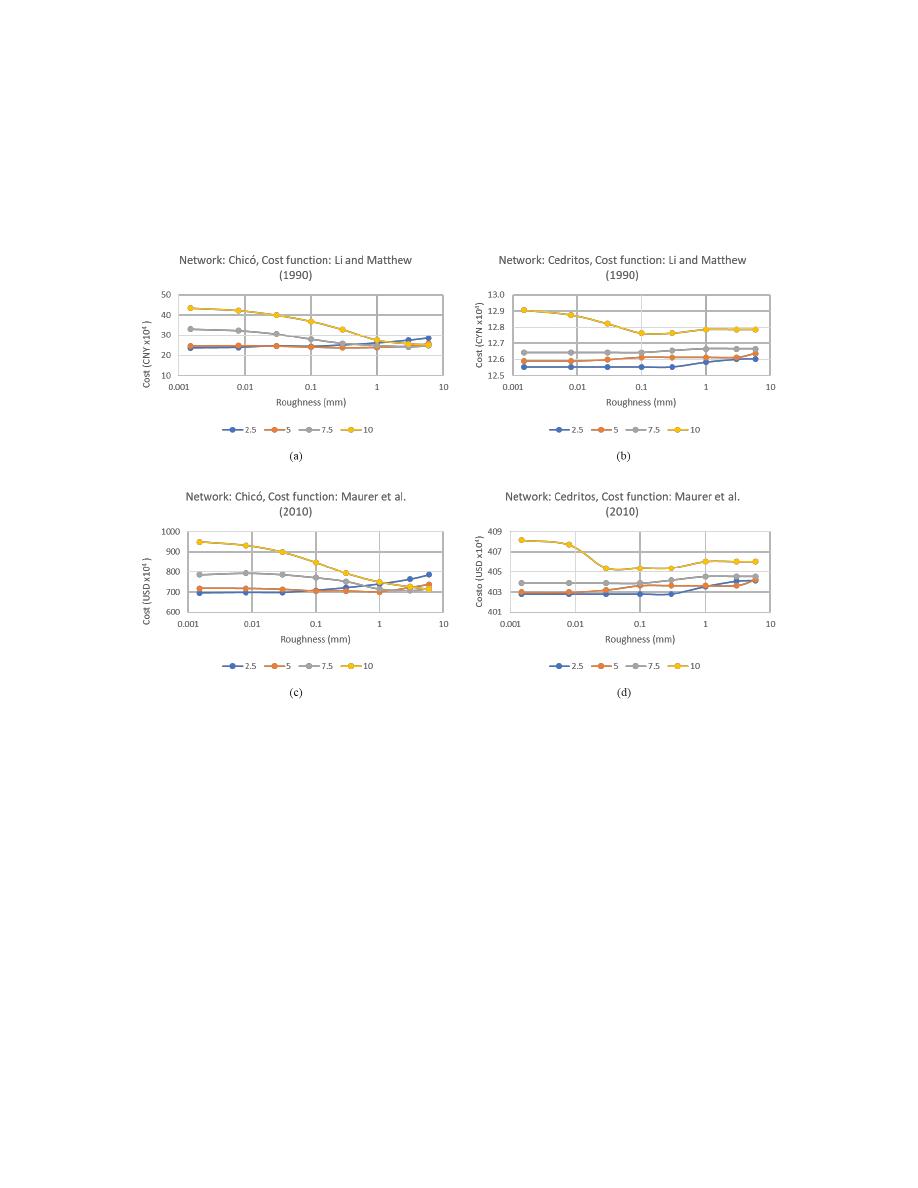
The results achieved are presented in Figure 1. This figure illustrates the cost of the designs obtained
in the two case studies using the two cost functions.
Figure 1. Results of the sensitivity analysis
Figure 1 illustrates that designs with steeper slopes and lower roughness resulted in higher costs. This
is because these conditions require more energy dissipation to meet hydraulic constraints, resulting
in a greater need for drop manholes, ultimately increasing the overall cost of the design.
Additionally, the results showed that there is an optimal range of roughness values for achieving the
lowest cost design, but this optimal roughness varies for each sewer network. For example, in the
Chicó network, the lowest cost designs were obtained with a roughness value of 0.1 mm, while in the
Cedritos network, the lowest costs were achieved with a roughness less than 0.1 mm, except for
designs with a 10% slope where drop manholes were required in low roughness conditions. For this
slope, the lowest cost designs were found to be around 0.1 mm.
Moreover, Figure 1 indicates that the cost function has little effect on the results, as the graphs for
each network display similar behavior.

Conclusion and Perspectives:
• There is an optimal range or value of roughness where the lowest construction cost are
obtained. However, this optimal roughness varies in each sewer network.
• Drop manholes increase the overall cost of the sewer networks, but under certain terrain
conditions, these structures are necessary to meet all hydraulic constraints.
• Designs with steeper slopes typically require more energy dissipation, resulting in a greater
need for drop manholes to ensure proper hydraulic operation.
• Any cost function could be used in the methodology for the sewer network design in hilly
regions, since it has little effect in the results achieved.
References:
Duque, N., Duque, D., Aguilar, A., & Saldarriaga, J. (2020). Sewer Network layout selection and
hydraulic design using a mathematical optimization framework. Water, 12(12), 3337.
https://doi.org/10.3390/w12123337
Li, G., & Matthew, R. G. (1990). New approach for optimization of Urban Drainage Systems. Journal
of Environmental Engineering, 116(5), 927–944. https://doi.org/10.1061/(asce)0733-
9372(1990)116:5(927)
Maurer, M., Wolfram, M., & Anja, H. (2010). Factors affecting economies of scale in Combined
Sewer
Systems.
Water
Science
and
Technology,
62(1),
36–41.
https://doi.org/10.2166/wst.2010.241
Saldarriaga, J., Herrán, J., & Iglesias-Rey, P. L. (2023). Optimal Sewer Network Design for Cities in
Hilly Regions. [Manuscript submitted for publication].
